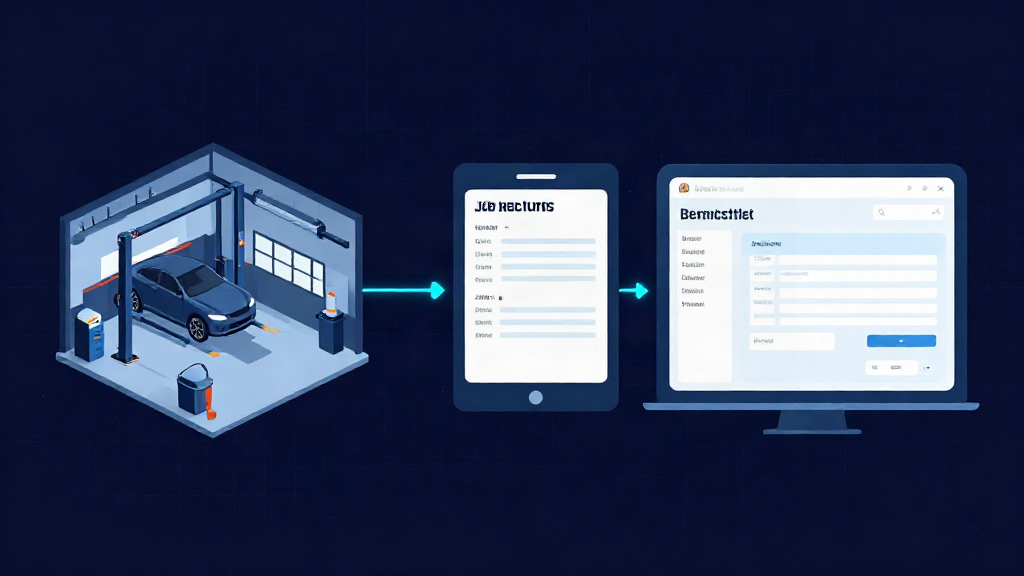
Quoting a job looks simple from the outside. A customer rings up, you work out the labour, add the parts, and send a figure back. In practice, quoting a job in a garage is where a lot of the day quietly disappears. You stop what you are doing, hunt for the right labour time, check a parts price, write it out, then write it again somewhere else when the job is booked in.
The good news is that quoting does not need to be clever. It needs to be consistent. A garage that quotes the same way every time gets faster, looks more professional, and argues less about the final invoice. Here is a routine you can run today, and a look at how to stop the copy-paste cycle that follows it.
What a good garage quote needs to include
A quote is not just a price. It is a short, clear document that sets expectations before you touch the car. Whatever system you use, these pieces should always be there.
Labour. The hours you expect the job to take, at a rate you have agreed with the customer. Be specific about what those hours cover, so a longer-than-expected strip-down is a conversation, not a dispute.
Parts. Itemised, with a part number or a description the customer will recognise. “Front pads and discs, both sides” is clearer than a single lump figure.
VAT. Quote it properly. Show the net figure, the VAT at the current rate, and the total, and make clear which parts of the job it applies to.
Assumptions and exclusions. This is the part most garages skip and later regret. Note anything you have assumed: that the vehicle arrives with no seized fixings, that a diagnostic scan is or is not included, that wheel alignment is quoted separately. A quote that names its assumptions protects you and reassures the customer.
Validity. Say how long the price holds. Parts prices and your own diary both move.
A repeatable quoting routine that stops details being retyped
Speed in quoting comes from a routine, not from rushing. Set one up and stick to it.
Start from the job, not from a blank page. Capture the vehicle, the registration, and the complaint once, at the point the customer first gets in touch. Every later document should pull from that record rather than starting fresh.
Work from a known labour time. Use the same source every time – your own experience, a workshop data reference, or the manufacturer’s guidance – so your hours are consistent across the team. If two people quote the same job differently, the customer will notice.
Build the parts list as a list. Add each part as its own line with a number and a price. It is easier to read, easier to adjust, and easier to hand to the parts supplier.
Write the assumptions in as you go. Do not leave them for the end. The moment you decide “assuming nothing is seized”, type it.
Send it before you move on. A quote that sits in a draft for two days is a job that someone else books.
Moving a quote into a job card and invoice without re-entering anything
Here is where most of the lost time actually lives. The quote goes out, the customer says yes, and then the same details get typed again on the job sheet, again on the parts order, and again on the invoice. Every retype is a chance to make a mistake, and every mistake costs someone a phone call.
The fix is to make the quote the start of one connected record rather than a separate document. When the customer approves, the quote becomes the job card. The labour and parts you already listed sit on the job sheet the technician works from. When the work is done, those same lines become the invoice, with the actual hours and parts adjusted where they differ from the estimate.
That is the workflow Workshop Pulse is built around: connect the job from booking and quote, through the job sheet and invoice, with payment tracking in the same place. Bookings, job cards, quotes and invoices, a customer portal and video inspections sit in Core, so the front desk and the technicians are looking at the same job, not two versions of it.
The small habits that keep quotes accurate
A few habits make the difference between a quote that stands up and one that causes grief later.
Agree variations in writing. If the customer adds a job, or you find something once the car is on the ramp, quote the change and get it approved before you do the work. “While you are in there” should always come with a number.
Keep the customer in the loop. A quick update on a job that is running long is worth more than a perfectly worded invoice at the end.
Review your quotes monthly. Look at the jobs where the final invoice drifted far from the quote. If the same job type is always under-quoted, your labour time or your assumptions need updating, not your memory.
Try the routine on one real job
You do not need to change everything at once. Pick one job this week and run it through the full routine: one record from first enquiry, a quote with labour, parts, VAT and assumptions, then straight into the job card and invoice without retyping a thing. See how it feels on a real car before you commit to anything.
Workshop Pulse is built by a technician with more than 30 years in the workshop, for UK independent garages and teams of around three to six technicians. Core is £149 per month per garage, excluding VAT where applicable, with unlimited employees, support and updates included. Standard software onboarding is free for eligible new UK garages signing up by 31 December 2026; bespoke migration and optional extras are quoted separately. Your 14-day free Core trial starts when your workshop is ready. No card is required, there is no automatic payment, and continuing on a paid plan requires your separate authorisation. Prices and full package details are on our plans page.
If quoting is where your day keeps disappearing, start with the trial or have a straight conversation with us about whether the workflow fits your garage. The best proof is a real job, quoted and invoiced the easy way.